


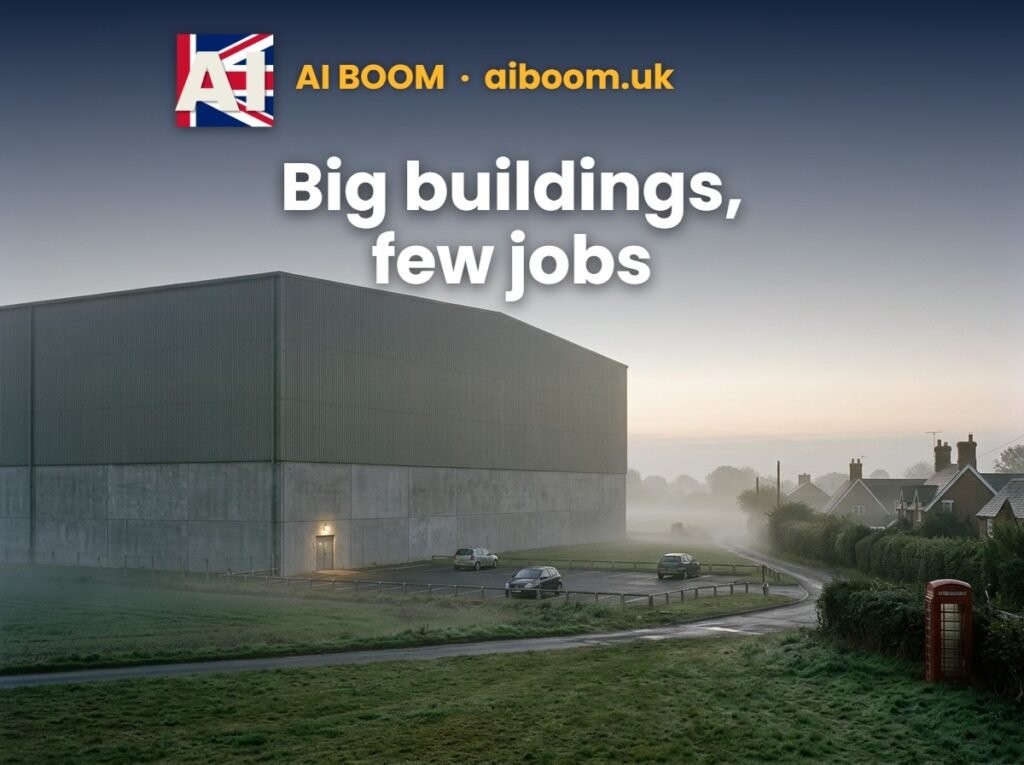
Data centres are the engine rooms of AI. They are also being thrown out of towns across America. The big question: do they actually create jobs?
The short answer is yes, but far fewer than the headlines suggest. This is research from the US, but the same arguments are coming to British towns, so it is worth a look.
How many jobs, really?
Two recent US studies tried to count. One looked at 1,584 data centres opened between 2000 and 2023. It estimated about 2.7 permanent jobs for every megawatt of power capacity. That means a mid-sized, 100-megawatt site brings roughly 270 jobs, counting the knock-on growth later.
A second study, from the Brookings Institution, found roughly 100 to 200 jobs in a typical county. Wages did not change. House prices rose by 2% to 5%.
That is useful for a small town. It is not the “thousands of jobs” you see in press releases. Most of those are building jobs, and they end when the building is finished.
So what do towns actually get?
- Tax money. In Loudoun County, Virginia, data centres supply about 39% of the county budget. The council has cut its property tax rate from $1.145 to $0.805 per $100 since 2016. That is the county’s own figure.
- Some tech jobs. Big cloud campuses create fibre, network and IT work nearby.
- Short-term building work. Plenty of it, but only for a year or two.
And what do they cost?
Electricity bills are the big worry. In one large US power region, supply costs jumped from $2.2 billion to $14.7 billion in a single year, and data centres drove nearly two-thirds of that rise, according to sources Brookings cites.
Then there are the tax breaks. In Texas, a data centre tax break cost about $5.4 million in 2015. State senators now project $3.3 billion for 2028 to 2029. Brookings also found incentives are only about 2% of investment for the big cloud firms, but about 62% for landlord-style data centres. In other words, the biggest subsidies go to the buildings that deliver the least.
Can the deal be better?
Some places are trying. Ideas on the table:
- Pay your own way. New “large load” electricity tariffs make data centres pay for the grid upgrades they need.
- Heating homes. In Finland, Microsoft and a utility planned to warm homes with data centre heat. Check whether it is up and running before you celebrate.
- Signed community deals. Draft agreements in US cities cover noise, water, local hiring and training. They are still proposals, so the test is whether they get delivered.
- Prove the jobs. Pay back the tax break if the promised jobs do not show up.
What is happening in the UK?
Britain is in the middle of its own data centre rush. London already has about 1,376 megawatts of capacity across 134 sites, with another 278 megawatts under construction (Cushman & Wakefield, June 2026). On 28 August the Green Party called for a pause on approvals for large new sites. The government said no, arguing a freeze would push investment and jobs overseas.
Here is a snapshot of recent and planned UK sites. Sizes are in megawatts (MW) of capacity.
Open now
- Google, Waltham Cross, Hertfordshire. Opened in 2025 as part of a two-year, £5bn UK investment plan.
- Kao Data, Harlow, Essex. Two 10MW sites are running.
- Pulsant, Milton Keynes. A 1.2MW hall built for AI work, backed by £10 million. Finished in February 2026.
Being built or approved
- QTS and Blackstone, Cambois, Northumberland. A £10bn campus on the old Blyth power station site. The first phase was approved in December 2025 and site preparation has started.
- Colt, Hayes, west London. Three huge buildings, 97MW and £2.5bn. Approved, but the high-voltage power supply is not due until October 2027. The first building should go live in early 2029.
- Pure Data Centres, Brent Cross, north London. Under construction.
- Yondr, Slough. A third building of about 40MW, on a campus of more than 100MW.
Planned
- Elsham, North Lincolnshire. About 1,000MW (1GW) across 15 data halls. Planning permission was granted in March 2026, and building is targeted to start in 2027. One report puts the cost near £7.5bn.
- Nscale, Loughton, Essex. 50MW, growing to 90MW. Microsoft will use it. The planned launch is early 2027.
- CyrusOne, Iver Heath, Buckinghamshire. 90MW. Groundbreaking was expected in the third quarter of 2026, with first capacity in early 2028. Check the planning status before you rely on this one.
- Clearstone, Ebbsfleet, near Dartford, Kent. A 145-acre AI campus, reported at 300MW, with the first building targeted for 2030.
- Culham, Oxfordshire. The first AI Growth Zone. It starts at 100MW, with a goal of 500MW.
- DataVita, Lanarkshire, Scotland. An AI Growth Zone with a 500MW target. It secured a £300m financing package in August 2026.
On hold
- OpenAI’s Stargate UK, Cobalt Park, North Tyneside. OpenAI paused it in April 2026, citing high energy costs and regulation. It says it still plans to come back.
These details come from industry trackers and press reports, and some sites have changed since they were announced. An AI Growth Zone label is not planning permission, so check each project before you quote it.
The AI Boom Team take
Data centres are not job factories. They are power-hungry buildings that serve users everywhere while the noise, land and bills land on one town. A fair deal makes them pay their own way, proves what they promise, and leaves something local and visible behind. One caution: most of the evidence covers older sites, and today’s giant AI campuses may behave differently.
Sources: Brookings Institution (Bahar and Wright, updated 10 August 2026), Loudoun County, Texas Tribune, Fortum, a published summary of the 1,584-facility study, Data Centre Axis, Place North East, Construction Magazine UK, DCD and Baxtel for the UK sites. Some figures come from secondary reports. Research by GO-IBR.com. Published 30 October 2026.
By the AI Boom Team. © aiboom.uk